Priscilla Kibbee

I love to travel all over the globe shopping for textiles to add to my wearable art. I have taught quilting to school children in Nepal, seminole patchwork to seamstresses in Thailand, and jackets and embellishment to quilters in Turkey where I also served as a judge at 2 of their International Quilt Shows. I have created garments for 5 Fairfield and Bernina Fashion Shows and teach classes on embellishment and wearable art. Lately I have been leaning more toward making art quilts.

Monday, July 2, 2012

A Typical Mayan Kitchen in Guatemala


Probably the only unusual thing about this kitchen in the Guatemalan Highlands is that it is inside.  Many that I have seen are just an open area with perhaps a fence and an attempt at a partial roof. 

Of course there is no such thing as a refrigerator, or electricity, or even a real stove.  If families are lucky they have a propane stove.  From the soot on the walls it looks like this family cooked over an open fire. 

Labels:

Friday, January 6, 2012

The Children of Guatemala are Starving

The Children of Guatemala are Starving - From the Tico-Times.net


Paulina Noj sits with three of her eight children.


.CUYUTA, GUATEMALA – Children in Guatemala are starving. But like their parents, one might not notice.

There are few bones jutting out, few oversize heads and bellies. But a slow, deep hunger has been building in Guatemala for decades. And now it’s destroying a generation.

In the drab-sounding hamlet of Lote 14 (Lot 14), 100 kilometers south of the capital in the department of Escuintla, 2-year-old María sits still on her mother’s lap, her twig-like arms dangling limply. Weighing a third less than she should, María looks frighteningly small. Staring at the mud floor of their empty kitchen, her mother, Paulina Noj, explains the daily struggle to feed María and her other seven children.

Her husband is lucky – despite rampant unemployment, he has a job, but he only earns $40 a week. Before, that was just enough for them to buy the basics – corn and beans. But rising food prices have doubled the cost of corn over the past year and they can no longer get enough to feed all 10 in the family.

“Everything is so expensive now that sometimes we just can’t buy corn,” Noj said. “There isn’t always enough to feed the kids.”

Clearly hungry herself, Noj can’t produce breast milk to feed her little girl, and has helplessly watched her get “very skinny.”

But skinny, small children are so normal here that it took Noj months to understand there was a serious problem. In fact, few Guatemalans find it odd that 4- and 7-year-olds will often look the same age.

Almost half of Guatemalan children suffer from chronic malnutrition; in rural Mayan areas it’s worse. And this slow hunger means that physical growth is being stunted as bodies are deprived of vital proteins. Malnutrition also has an invisible effect on the mind in the form of diminished brain development.

Malnourished children like María, who suffer physical and cerebral starvation in their early years, will never recover. Willem van Milink Paz, a representative for the World Food Program in Guatemala, calls chronic malnutrition a “life sentence” that condemns generation after generation.

The dimensions of the problem are already immense, and they continue to grow. According to UNICEF, Guatemala has the fourth-highest rate of chronic malnutrition in the world, lagging behind just a few arid countries, including Afghanistan.

Looking around Guatemala’s lush landscape – dominated by plantations of bananas, sugar cane, coffee, and corn – this seems impossible. But historic inequality means that half this land is owned by only 2 percent of Guatemala’s 14 million people. Wealth is similarly concentrated, making Guatemala one of the least-equal societies in the world. And with the region’s lowest tax rate of 11 percent, change is unlikely soon. The result is that the majority of Guatemalans live in miserable poverty, struggling to access land, jobs, education, health care, and now food.

In the last few years, climate change has brought a series of natural disasters and erratic rainfalls that destroyed small plots of land many subsistence farmers depend on to feed their families. No longer able to grow crops, more Guatemalans have to buy food.

Religious and cultural beliefs have made family planning unpopular, so rural couples often try to feed six or seven children on incomes that can barely feed two.


Aid workers weigh Arazeli, a dangerously malnourished 2-year-old Guatemalan girl.

Natasha Pizzey-Siegert Rising food prices globally and locally have made life even harder for many Guatemalans. “We are talking about a 60 or 70 percent rise in food prices since January last year. That’s basic food. … Corn is at the highest [price] in history right now”, said Van Milink Paz.

“Last year we could buy six corn tortillas for 12 cents; now we get three or four,” said Noj. Even beans are out of her reach now, and luxuries like eggs and meat are unthinkable.

It’s hard to imagine her daughter María making it to school. But if she does, she will likely find that up to eight in 10 of her classmates will be malnourished too. Their stunted brains will struggle to keep up in class, and many will fall years behind in school.

They will be sick often with diarrhea and respiratory disorders that will make them lose even more weight. Some may die.

Those who live will grow up to be weak adults with a reduced physical and mental capacity. Ultimately, they will start the cycle again: malnourished parents producing malnourished babies.

Inevitably, this cycle is stunting Guatemala’s development. Billy Estrada, undersecretary of food security for the Guatemalan government, admits, “We can’t even guess how much this is costing [the state] because it’s just so big.”

The costs of repeated school years, emergency health care and food handouts can be estimated, but the earnings lost because Guatemalans have been malnourished en masse are immeasurable.

“When these malnourished children are men, … maybe they will work the land, but they won’t be able to fully develop. … It will be hard for them to come up with ideas to start their own business and so on,” Estrada said.

Despite the obvious and urgent need for the government to tackle this problem, lack of political will and fiscal constraints have held back progress. The latest aid programs run by outgoing President Álvaro Colom were widely accused of being vote-buying schemes for their lack of transparency.

Estrada insists that the real problem has been a lack of consistency in programs. Turning them into a long-term strategy protected from politics is essential. But with a new government coming in January likely to overhaul all existing programs, underdeveloped children with underdeveloped brains look set to be Guatemala’s destiny.


Labels: ,

Monday, December 19, 2011


From Mayan Families, An NGO in Panajachel, Guatemala

Families Receiving Tamale Baskets

Thank you all for donating for families to receive Tamale Baskets! Families are filling the streets waiting to receive theirs, and it is a beautiful, joyful sight.

However, some families are coming around that have not had confirmation of receiving their donation. These families are crowding our gate, hoping to receive word.


Donate now to give the feeling of relief and gift of a Tamale Basket for Christmas. Just $35 will feed up to 10 people. To donate go to:

www.mayanfamilies.org/DonateOnline

Labels: , ,

Sunday, December 18, 2011

Trip to Guatemala Part Four- Last Days in Panajachel

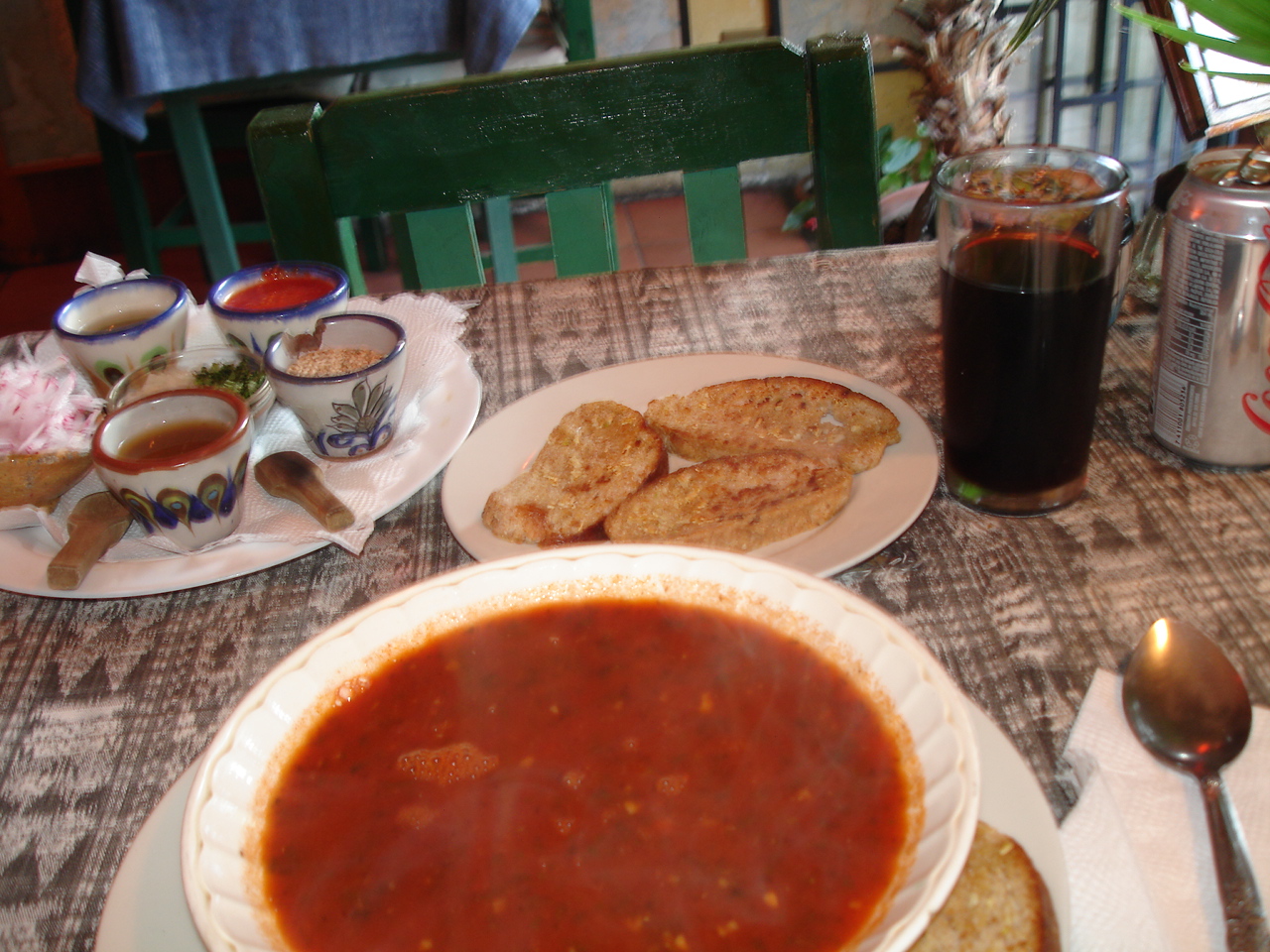
Up to the lovely little Vegetarian Restaurant just up the street for some wonderful Dutch Tomato Soup full of basil and some garlic bread. Isn't the condiment dish they serve with it a beauty. Made just next door in San Antonio Palopo. Soup, garlic bread and a diet coke costs about $8.70. Plus tip of course.

Ok, ok. Here's the banana split photo. Actually there are at least four places in town for one. One is them is half a block from my hotel. And two spots for delicious cheesecake. One just a block away. Its really rough being here. A banana split is about $3.70.


On weekends there are more people in town, usually from Guatemala City so there are more vendors set up on the main street.


I have gotten very well acquainted with this women from Santiago Atitlan who is a sort of huipil broker...selling huipils for other women for a small commission. I see her in Santiago and this time here in Panajachel in the restaurant where I was eating lunch. I have bought quite a few from her but prefer to purchase them from the makers.


The view from the restaurant. It doesn't get much better than this.


Every once in awhile I find a really nice piece on my travels. This trip a woman sold me what I assume was a small baby carrier which is really heavily embroidered. There is even a little mended spot around the middle of the stripe down the center. Really quite lovely in person. A soft dark green.

Labels: ,

Saturday, December 17, 2011

Trip to Guatemala Part 3- Parade in Panajachel

After what seemed like a long wait the parade finally began. Fortunately it was in front of my hotel so I could go in and out of my room while I was waiting.

The parade was in celebration of the "Burn the Devil" Festival . Or a Feast of the Virgin. Or Both? These are supposed to be two famous Soccer Players or something like that. I have no idea who.

After parading for awhile they danced up and down the street.


I am not quite sure what these figures have to do with beating the devil but they were very popular.

There have been firecrackers going off for days and fireworks over the Lake at night.


We had seen the same parade during the day in Solola , up the mountain and in Chichicastenango , an hour or so away. The paraders must be awfully hot under those costumes and tired by now.


Labels: ,

Thursday, December 15, 2011

Trip To Guatemala Part Two, Chichicastenango Market

Thursday and Sunday are Market Day in Chichicastenango. There are always flower sellers and a flurry of activity in front of the main church on the square.


There was also a Mayan ceremony in the church. No photos allowed of course.


Restaurant inside the market. The market wasn't as crowded today. There were fewer tourists around.
On the way back to Panajachel we stopped for some photos of Lake Atitlan at the overlook.


Back in Panajachel a crowd was gathering in front of my hotel for a parade. The view across the street.
And food vendors were setting up of course.

Labels: , , ,

Tuesday, December 13, 2011

A Week in Panajachel, Guatemala


Another great week in Panajachel, Guatemala. As usual I stayed at the wonderful Posado de las Volcanes. One morning I came out to what I thought was a woman's voice saying "Hola" (hello) and it turned out to be this beautiful parrot!

Lunch at a local vegetarian restaurant. I have to be occasionally good to make up for all the pancakes and cheesecake I eat here, as well as banana splits.


The second day I took the trip across the Lake to Santiago Atitlan.


While the lake looks peaceful here the wind came up and it was a really really bumpy ride in a small boat.


Guatemalan Rule #14. Don't cross the lake when its windy and wavy.


Guatemalan Rule #15. If you ignore Rule 14, don't try it with an open soda can.


My favorite huipils are made in this village, almost all containing bird motifs. I also purchase many of my beads from the women in this village who make the jewelry.
A family friend named Bob. My son in law used to sponsor him in school. He is now 26 and married with two children. His wife now makes beaded jewelry.
I bought this one. Its machine embroidered but absolutely beautifully done. The work is done on a treadle machine.
Part of the weekday market in Santiago Atitlan.

Labels: , ,

Monday, December 12, 2011

Why Not Sponsor a Guatemalan Student?

Sponsor a Guatemalan Student


(A message from Mayan Families, an NGO in Panajachel, Guatemala.)


Schools in Guatemala are out for their three-month break, and we want to send a big thank you to everyone who sponsored a student this year.

Thanks to your help we have sponsored over 2,000 children to go to school this year! But despite this progress, many in the Sololá region are still without access to education: while 86% attend Primaria (Elementary School), older students are often forced to drop out and work. Only 19.6% complete Básico (Junior High School grades 7-9), and only 7.9% complete Carerra (High School grades 10-12).

The consequences of dropping out follow students for the rest of their lives. A Carerra education provides training for work in tourism, teaching, business, medicine, mechanical work or a host of other steady, higher-wage professions. Without this education, students are confined to unskilled labor-jobs that will never bring in more than a few dollars a day.

The gift of a Elementary, Junior High School or a High School education will bring students benefits that last a lifetime. A sponsorship for a year for Elementary School costs $190, Junior High School costs $390, a year of High School costs $490 and a University Education costs $1,250 a year. To read more about the student sponsorship program, and to meet some of the students seeking sponsors, click here.


Labels: , ,

Friday, July 1, 2011

Mayan Families in Panajachel, Guatemala

Lake Atitlan is one of the most beautiful places in the world. But up in the hills, where the Indians live, some of the most terrible poverty still exists. Mayan Families, a wonderful NGO works with these families and helps find scholarships for many of their children to attend school and have a better life. Here is the story of one volunteer who is working with Mayan Families:


Carmen's Trip to Tierra Linda.
Tuesday, June 28, 2011


Tierra Linda


We arrived in Panajachel on Saturday and soon it started to rain. It rained all day Sunday and when we woke up on Monday we saw that it was cloudy once again. It was an inconvenience for us, only because we would need to wear our raincoats and the kids were not going to be able to use the hotel pool. What I did not imagine was the misery it really brings to some people here.

I met some employees from Mayan Families early on Monday morning and we left Panajachel to deliver food and supplies to the preschools that Mayan Families runs in San Jorge, El Barranco and Tierra Linda. On the way to San Jorge we saw that there had been a huge mudslide earlier in the day and huge boulders were blocking one lane. Some municipals workers were trying to clear the road but it was obvious it would take a long time and more equipment to move all those huge rocks. Buses were not allowed on the road, only smaller vehicles. I am sure that affected a lot of people that were counting on the buses to transport them.

When we arrived in Tierra Linda we delivered the supplies and then left to visit some families, guided by the preschool teacher. She brought us to the most remote homes in the village. The road was blocked by a fallen tree and we had to walk. It was extremely muddy but it got worse once we took the small pathways and it started to rain. We first visited the home of Rolando, a sponsored student by Mayan Families. He was taking a bath next to a tank where they collect water. It was cold and he was trying to do it quickly. We visited his home and I was shocked to see the state of the walls. They were made of mud bricks and there were cracks all over. The floor was made of dirt and it was starting to get wet. I am sure it would soon turn to mud. It was a very small room. There were two small beds and only one had a thin mattress. They showed us another room where the grandmother and the two smaller kids slept. It was just wooden boards on top of some blocks and it did not have a mattress. They only had a couple of blankets.

We visited other homes nearby and they seemed to be even worse. I have been to Guatemala 4 times but these were the worst living conditions I had ever seen. The houses were made of mud brick that was falling apart. The walls had pieces of mud missing in some places and the owners had put plastic to try to cover the holes but you could still see light coming through them. These homes seemed like they could fall down any minute. Some of them were right on the edge of the clif and they were in danger of falling down all the way to the bottom of the mountain. There rooms were very dark and some homes did not have electricity connected so they would stay that way day and night. Some had Onil stoves donated by Mayan Families and their supporters and thankfully, there was no smoke in the rooms. There was mud everywhere and most of the kids were barefoot. I felt like crying and I was mad. I could not believe those were their homes and they had to be there every day.

I thought I had seen the worst and then we got to the home of Rudy, Yesica and Josue, also sponsored to attend school. The mother was boiling some water and there was smoke all over the room they use as kitchen. They showed us the rest of the house, a room with space for a small cot and a small bed. The cot did not have a mattress and a very thin blanket of top. You could feel the wires and I could not imagine having to sleep on top of that. The other bed did not have a mattress either. The walls were covered with plastic in some places to cover the holes on the mud brick. It looked like it could fall any minute. The mother told us the husband had left 3 weeks before and she did not have any money to buy food for her children. She had only been able to get a couple of jobs cleaning onions but it was very difficult to find jobs. There was no food at the home and I mean nothing, not one potato or beans, or corn. I felt so powerless. I looked in my pockets and I only had 25 quetzals to give her. I had forgotten to exchange money and I had nothing else to give her. She was very grateful and said she would buy corn flour to make tortillas for her children. It was raining very heavy, the closest store was in the center of town which meant she either had to leave the kids home alone while she tried to walk in the mud and rain or one of children would have to make the trip to buy the flour.
We had to leave but promised to try to do something for her. She was crying saying she was desperate, that she wished she could take poison to end it all. It broke my heart to hear her say that because her children where right there. All the way down the mountain I was mad and I stayed mad all day. Life is so unfair to some people. I don't understand why and it makes me mad. I just hope I will stay mad long enough to do something for her and the other families.


If you are interested in the work which Mayan Families does check them out at:


www.mayanfamilies.org


Labels: , , ,

Thursday, April 21, 2011

The Circus Comes to Panajachel

While Panajachel is a tourist destination on beautiful Lake Atitlan in Guatemala, in reality it is a tremendously poor community. The number of people living below the poverty level hovers somewhere around 70%. And that is a pretty low level of existence here. So when the Circus came to town from Mexico it obviously wasn't going to be possible for most children to be able to attend. When many families exist on tortillas and salt for food it was a luxury .

So Mayan Families... a local NGO...took matters in hand and rounded up a group of sponsors to send the children at a special rate they were able to negotiate. They quickly raised enough funds and arranged transportation to take every pre-school and many higher grades from a number of schools around the Lake. Here staff members wait with some of the children at the entrance.


Waiting patiently for the show to begin.


Lions and tigers and bears...oh my. But it was also lots of fun to interact with cartoon caracters.


After the circus it was time for a visit to the Mayan Families office for some new clothes.


And snacks of course. If you would like more information on Mayan Families and the wonderful work they do visit www.mayanfamilies.org

Labels: ,