Priscilla Kibbee

I love to travel all over the globe shopping for textiles to add to my wearable art. I have taught quilting to school children in Nepal, seminole patchwork to seamstresses in Thailand, and jackets and embellishment to quilters in Turkey where I also served as a judge at 2 of their International Quilt Shows. I have created garments for 5 Fairfield and Bernina Fashion Shows and teach classes on embellishment and wearable art. Lately I have been leaning more toward making art quilts.

Sunday, February 20, 2011

Trip to India & Nepal - Boudha Part 3

A local barber shop

There are a couple of Thanka Art Schools around the Stupa. We visited one and Michael bought a Thanka.


I loved this one. Many of the finer ones have considerable touches of gold paint.


They are painted with tiny brushes and can take weeks to complete. A Thanka is a Tibetan silk painting with embroidery, usually depicting a Buddhist deity, famous scene, or mandala of some sort. The thanka is not a flat creation like an oil or acrylic painting. Rather, it consists of a picture panel which is painted or embroidered, over which a textile is mounted, and then over which is laid a cover, usually silk. Generally, thankas last a very long time and retain much of their lustre, but because of their delicate nature, they have to be kept in dry places where moisture won't affect the quality of the silk. It is sometimes called a scroll-painting.

Originally, thanka painting became popular among traveling monks because the scroll paintings were easily rolled and transported from monastery to monastery. These thanka served as important teaching tools depicting the life of the Buddha, various influential lamas and other deities and bodhisattvas. One popular subject is The Wheel of Life, which is a visual representation of the Abhidharma teachings (Art of Enlightenment).

To Buddhists these Tibetan religious paintings offer a beautiful manifestation of the divine, being both visually and mentally stimulating.

Thanka, when created properly, perform several different functions. Images of deities can be used as teaching tools when depicting the life (or lives) of the Buddha, describing historical events concerning important Lamas, or retelling myths associated with other deities. Devotional images act as the centerpiece during a ritual or ceremony and are often used as mediums through which one can offer prayers or make requests. Overall, and perhaps most importantly, religious art is used as a meditation tool to help bring one further down the path to enlightenment. The Buddhist Vajrayana practitioner uses a thanga image of their yidam, or meditation deity, as a guide, by visualizing “themselves as being that deity, thereby internalizing the Buddha qualities ."

This one was almost all gold and is a Wheel of Life thanka.


Thankas with the silk covering. Many of the ones for sale to westerners do not have the silk covering and are meant to be framed.

The beautiful tiger panel I have been coveting for years was still on display at the Stupa entrance.

The Stupa gate from the inside.

Labels: ,

Saturday, February 19, 2011

Trip to India & Nepal- Boudha Part 2

A local grocery store...a rather well stocked one near the Stupa
There was a demonstration of dancers from Korea while we were there. It attracted a crowd of course.

Standing on the Stupa gave you a good vantage point.


There always seem to be lots of monks in the area.
In the background is the Stupa View Restaurant which used to be (and may still be) the best restaurant in Boudha. There is a nice terrace on the top of the building with great views of the Stupa and their momos are among the best in town. Part of the movie..The Little Buddha...was shot here.

The balcony above the monastary is another good viewing point.

The eyes on the Stupa seem to follow you everywhere.

Because of the influx of tourists during the day there are always a few beggars.

And worshipers making their ritual walk around the Stupa.

A group of Tibetans watching the dancing.

Labels: ,

Thursday, February 17, 2011

Trip to India & Nepal- Boudha- Bodhanath

There is no place quite like Boudha. I was priviledged to live here for weeks at a time over the course of several years, volunteering as a teacher in the local schools. They were unforgettable experiences. This is one of the few places in the world where Buddhist culture is accessible and unfetered, and the lanes around the stupa are crammed with monastaries (over 40 at the moment) and workshops turning out butter lamps, ceremonial horns, plumed hats for Lamas, and other paraphernalia for Buddhist life. You enter through a gate off the main road.

The yellow on the stupa is marigold paint. Thousands of Buddhists gather daily to make the circumnavigation of the stupa. We used to love to sit at an upstairs window table at one of the local restaurants and watch.

With so many monastaries where are usually groups of monks on the street. The stupa is ringed by what originally was local homes. Most have shops at the street level.

Of course, lots of prayer flags are flying from the stupa.


One of the newer monastaries built around 12 years ago and replacing an old building on this corner.


All the monastaries are decorated with fabulous murals. This one is a little different as some of the murals are 3D.
Monks at their prayers.


The area used to be full of vacant lots. Not very many are left now.


Another monastary.
Shechen Guest House where I stayed for several weeks in 1996 with my two granddaughters when we were volunteering in a school here. It was called Rabsel House then and didn't have the furniture in the yard.

We had a triple room on the upper corner. We did our wash by hand and hung it on the roof. My older granddaughter was startled one night to find a monk praying on the roof when she went up to hang the laundry.

They now have a fancy restaurant in the garden. And the prices are quite a bit higher of course.

And the neighborhood is now all built up.

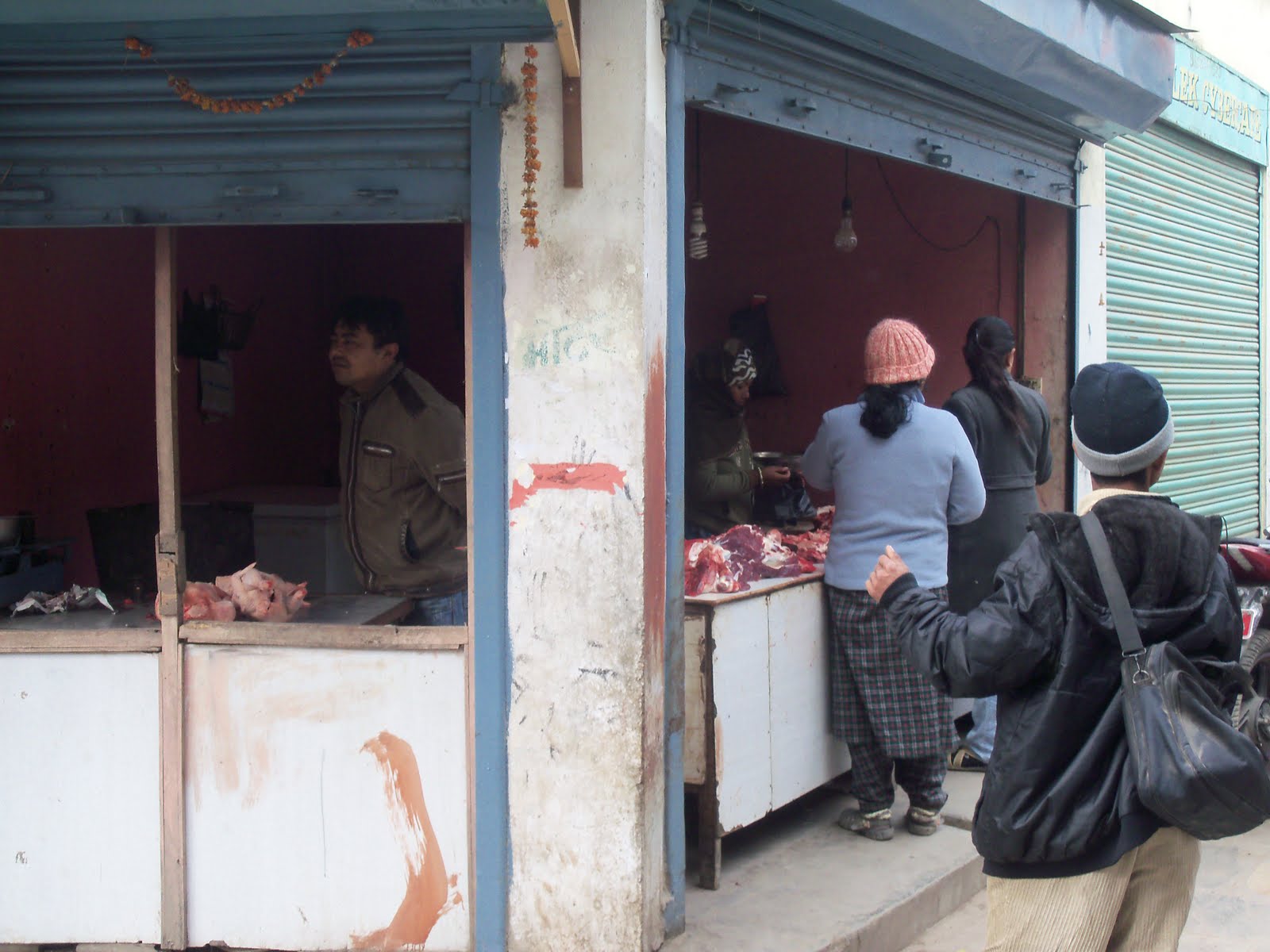
Well, ok, the meat markets have improved a tiny bit. There still is nothing resembling refrigeration. But they used to be just a little stand on the side of the dirt path. They would close down in the heat of the day and come back in the evening for returning home customers with a candle plunked in the middle of the meat to light it up for customers.

Labels: , , ,

Tuesday, October 16, 2007

A Day in Boudha

We made a day trip to Boudha, or Bodhnath, about 6 km. from Kathmandu. It used to be a separate community but most small towns have now been swallowed up in the constant growth in the valley. I spent many months here over a number of years teaching English in the local schools. Knowing how little the students have here to work with I always try to load up my suitcases when I come here with things they can use. Carolyn and I brought notebooks, crayons, pencils and pens this year. The stupa here is one of the world's largest and, of course, is the town center. The town is the religious center for a huge Tibetan refugee population who settled here in the late 50's after the overthrow of Tibet. They have prospered and there are now almost 30 Buddhist monastaries here.
Cars are off limits but there is the occasional motorcycle on the circle around the stupa.
And lots of shops selling Tibetan and other items. Unfortunately they are becoming more and more upscale every year. There used to be an old broken down brick building on this corner. It was torn down and this beautiful monastery built in its place.


Even cows need to take a break in the heat of the day.
One of my favorite restaurants here is the Stupa View on several floors with a nice rooftop terrace with views over the town.
Their momo's (vegetables in a wrapping like ravioli with tomato sauce) are terrific.
An elderly Tibetan woman with her prayer beads. In the morning and evening there is a fabulous view of scores of people walking around the stupa, turning the prayer wheel and saying their prayers using the beads and personal prayer wheels. I would often sit at the window of one of the upstairs restaurants surrounding the Stupa and watch.
A child dispatches pidgeons near the feeder.

Labels: ,